FindtechGroup.com Review: Appraising Capital Preservation Protocols against Systemic Global Macroeconomic Shocks
Trading in today's financial markets often feels like walking across a field that is constantly shifting beneath your feet. When liquidity drops out of nowhere, casual trading quickly turns into a massive, unnecessary risk. That reality forces platforms like Findtech Group to put safety ahead of social media hype. At the end of the day, keeping your balance intact matters way more than chasing a lucky streak.
Judging a trading setup during wild market swings means looking way past the superficial layers of a user interface. Smooth routing speeds and pretty dashboards are fine, but they do not tell the whole story. True operational quality comes down to how well the platform protects a user when things go south. It is all about the defensive design.
Having a real survival plan is what separates professional desks from casual retail accounts who just wing it. This FindtechGroup.com Review looks at how the platform builds its risk frameworks to keep balances secure. By leaning on automated, math-based models, the software helps strip impulsive panic right out of the daily routine.
Advanced Risk Engineering Metrics
Hoping for the best is a terrible strategy when global markets hit unexpected pricing glitches. Basic retail platforms usually just look backward at simple historical averages, but true account protection demands real-time statistical scrutiny.
This FindtechGroup.com Review looks closely at the tech built to catch and contain risk exposure long before an order even hits the matching engine.
Value at Risk (VaR) Boundaries and Parametric Limits
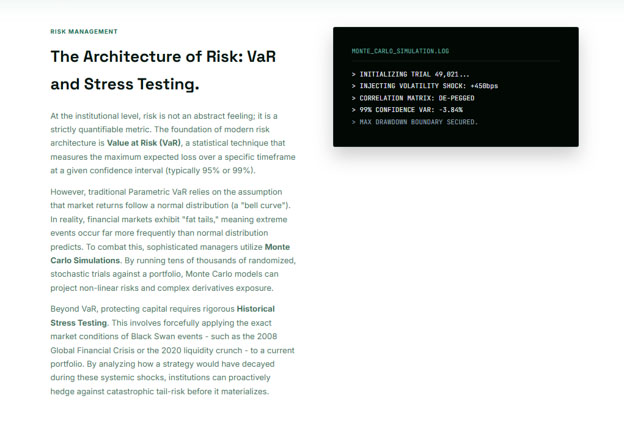
The primary line of defense relies on automated Value at Risk calculations running in the background. This detailed FindtechGroup.com Review continuously computes the worst-case loss an account might face over a specific window. To keep the math reliable under stress, the calculations operate strictly within a 99% confidence interval.
By using a data-heavy calculation base anchored in past volatility statistics, the platform sets firm risk boundaries for users. Real markets do not move in smooth, predictable lines. Because of this, the math specifically accounts for fat-tail risks, those rare, brutal moves that break normal forecasting models.
If an account's leverage or concentration gets too close to these limits, the system triggers automatic caps to cut off accelerating losses.
Stochastic Monte Carlo Simulation Logs
Static rules fail when complex modern derivatives start moving in chaotic, non-linear patterns. To ensure active risk settings can handle extreme anomalies, the backend processes continuous Monte Carlo simulations. The system runs tens of thousands of automated shock trials, mapping out randomized outcomes for multi-asset positions.
Analyzing these massive log files allows the software to project how derivatives will act during highly chaotic conditions. It lets margin requirements and risk metrics adjust dynamically as market stress rises.
This FindtechGroup.com Review confirms that these adjustments happen well ahead of sharp, highly correlated market drops, keeping traders from getting blindsided by sudden margin calls.
Historical Stress Testing and Shielding Asset Corridors
Theoretical mathematics might look excellent on a presentation slide, but it means very little if the framework collapses during a genuine market emergency. Serious risk management software must be tested against past financial panics to prove it can keep assets secure when global markets experience real chaos.
Black Swan Modeling Scenarios
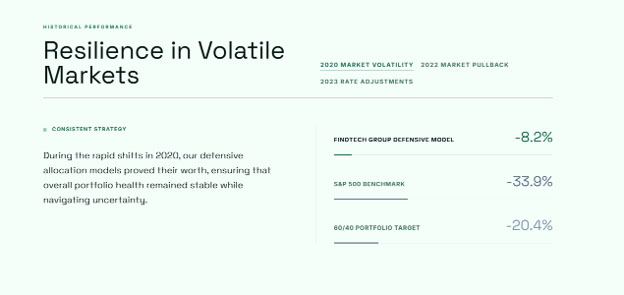
The risk management core takes simulated trading portfolios and subjects them to historical market shocks to see exactly where structural vulnerabilities emerge. It analyzes asset decay patterns by running positions through real-world liquidity crises.
This structural FindtechGroup.com Review notes that the system measures strategy rules against actual data blocks from major modern disruptions:
- The 2008 Financial Crisis: Recreating severe global credit freezes, rapid institutional downgrades, and extreme cross-asset correlations.
- The 2020 Liquidity Crunch: Simulating sudden flash crashes, massive spikes in the VIX volatility index, and the abrupt breakdown of standard historical hedges.
Observing how these risk boundaries perform under simulated black swan conditions provides the backend system with vital optimization data. It ensures that the defensive protocols stay calibrated for messy, panic-driven market selloffs rather than ideal conditions.
Third-Party Custodian Segregation
Advanced data metrics are excellent for portfolio tracking, but physical asset isolation is what truly neutralizes corporate counterparty danger. This operational FindtechGroup.com Review explores the methods used to keep company operational capital separate from the balances utilized for everyday participant trading.
All participant funds sit securely with established third-party banking institutions inside fully segregated accounts. This clear architecture ensures that client capital remains completely ring-fenced from the firm’s own corporate balance sheet.
To enhance security further, core asset reserves are kept in premium offline vault setups. This institutional design creates a strong shield that keeps user assets isolated from external digital vulnerabilities and corporate operational liabilities alike.
Corporate Security and Structural Feature Benchmarking
To really see where a risk setup stands, you have to stack its features up against the rest of the industry. The safety steps and data tracking tools used here are built to handle way more pressure than your average retail broker. They simply adjust a lot faster when things get messy.
Cross-Platform Risk Architecture Analysis
The breakdown below highlights exactly how the safety configurations at Findtech Group hold up against standard industry platforms and other feature-heavy setups. It covers the major risk and security categories to show where the structural differences actually lie.
Comparing these different setups helps clarify what goes on behind the scenes under real market stress. Standard brokers often cut corners on deep risk automation to save on server costs. Looking at the core tracking metrics makes it easy to spot which networks are actually built for heavy volume.
| Security & Risk Feature |
Findtech Group |
Industry Average Platforms |
Feature-Heavy Platforms |
| Capital Segregation Architecture |
Fully isolated via tier-1 third-party banking networks |
Co-mingled funds or single-tier centralized setups |
Variable banking setups with partial asset isolation |
| Risk Modeling Engine |
99% Confidence Interval VaR with Monte Carlo logging |
Basic historical drawdown charts and static metrics |
Standard VaR calculations missing automated shock tests |
| Account Access Defense |
Multi-factor authentication paired with encrypted keys |
Standard dual-factor access options |
Advanced login options using biometric software links |
| Systemic Liquidity Protection |
Real-time dynamic margin adjustments and cap limits |
Fixed margin alerts with manual processing delays |
Tiered margin schedules with slow override times |
Final Evaluation of Data-driven Risk Management Rules and Asset Isolation Measures
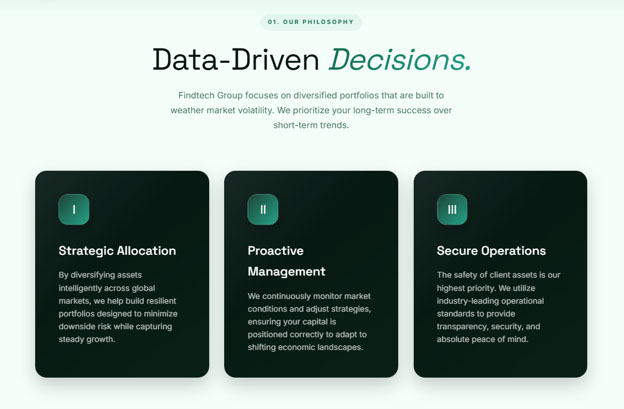
An analytical FindtechGroup.com Review reveals a digital infrastructure that places defensive precision far ahead of speculative hype. By integrating math tools like 99% VaR boundaries and automated Monte Carlo logging directly into the terminal, the platform steers regular users away from impulsive guesswork. It forces a much more disciplined, systematic approach to market exposure.
When you mix these data-driven strategy rules with solid structural protections, things become much more secure. Utilizing strict third-party bank segregation alongside regular black-swan stress testing results in a genuinely durable ecosystem. This setup gives the hardware resilience needed to navigate highly unstable global macroeconomic environments.
For serious market participants who want to focus on protecting their capital across volatile cycles, these integrated protocols provide a solid defense. The system essentially brings institutional-grade risk management down to the retail level. It is built to keep balances intact when wild market moves start breaking standard formulas.
|