
Leave Alice Springs heading west for Kings Canyon and your phone will probably show a strong signal as you pass the edge of town. Coverage soon thins out, and once you leave the bitumen where Larapinta Drive meets Namatjira Drive, you're on the Mereenie Loop: about 160 kilometres of corrugated dirt. After a blowout out there, the next car could be a long time coming.
That's the adjustment for overseas visitors. The outback isn't out to get you; it just expects you to cope alone for longer than you're used to.
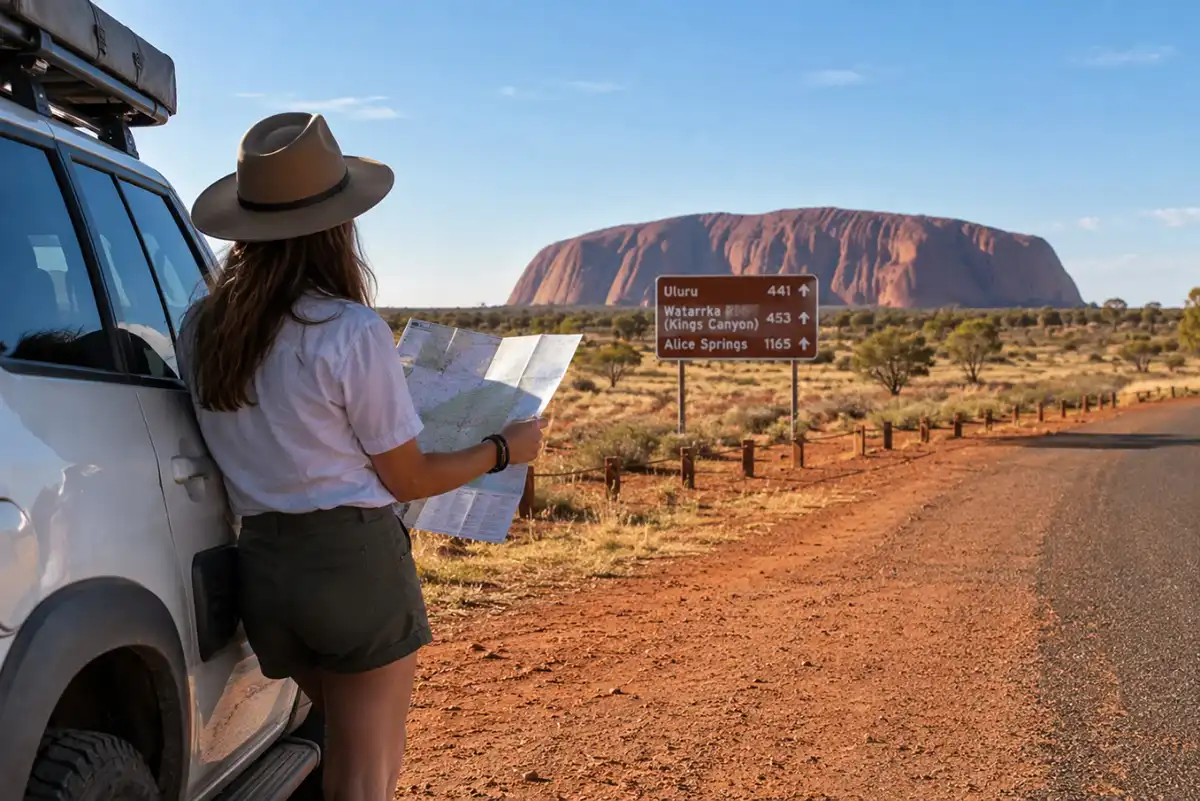
Locals call the Stuart Highway the Track. It's bitumen all the way from Port Augusta to Darwin, somewhere between 2,700 and 2,800 kilometres. Most first-timers stick to the Red Centre loop of Alice Springs, Uluru and Kings Canyon: Alice to Uluru is about 450 kilometres, close to five hours without a stop, and the sealed road to Kings Canyon takes about as long.
So plan shorter days than you would at home, and keep a day up your sleeve. Rain can make dirt roads impassable. The NT Road Report, South Australia's Outback Road Warnings and QLDTraffic in Queensland are worth checking before you leave and along the way.
Some outback roads cross Aboriginal land and need a permit. The Mereenie Loop's permit, the Mereenie Tour Pass, isn't sold online, says the Central Land Council. Collect one in person from the Alice Springs Visitor Information Centre, the Council's office in town or outlets such as Kings Canyon Resort. It covers three days, and camping along the loop isn't allowed.
Tourism Central Australia's advice is to take a four-wheel drive. Hire companies set their own rules, some ban unsealed roads outright, and ignoring that can void your cover. Ask, and get the answer in writing.
Top up whenever there's a bowser. Distances vary by route, and Tourism NT notes remote service stations keep restricted hours. In remote parts of four states and territories, the only unleaded on offer may be a low aromatic fuel, usually sold as Opal. It was brought in to stop petrol sniffing, and the federal government says any engine built to run on regular 91 can use it. If your car needs premium, ask the hire company.
Water advice varies. Tourism NT says four to six litres per person per day at a minimum. South Australia Police go higher: six in mild weather, ten when it's very hot, and enough for an extra three or four days on remote routes.
May to September is the cool season at Uluru, according to Parks Australia. Alice Springs gets about a dozen nights a year at or below freezing, mostly in June and July, Bureau of Meteorology records show. It also averages around 17 days a year of 40°C or more. Up north, the wet season runs roughly November to April, when floods close roads and driving on a closed one can bring a fine.
Signal in the outback tends to cluster around towns, roadhouses and parts of the main highways. In between there can be nothing. The networks don't all cover the same ground either, so it's worth knowing which one your SIM or eSIM uses and checking its map against your route.
Sorting out data before you fly saves hunting for a SIM on arrival. A Holafly travel eSIM is one way to do that, provided your phone supports eSIM and isn't locked to your home carrier. The company says its Australia plans use the Optus network and come with data only, not a local number. It also warns that coverage may be weak or missing on some Outback routes. That's true of any phone plan, so an eSIM is no replacement for a personal locator beacon or satellite device.
A call to Triple Zero (000) is free. If your own network has no signal but another one does, the call goes through on that one. On an overseas phone you can dial 112 instead; it reaches the same operators and doesn't jump the queue. Neither connects with no network at all; an ordinary mobile can't reach a satellite. The free Emergency+ app helps you read out your GPS location, but it can't call without coverage either.
That's what a 406 MHz personal locator beacon is for. Beacons coded for Australia have to be registered with the Australian Maritime Safety Authority, which costs nothing. One bought abroad is usually registered in the country it's coded for, so ask the seller. Leave your route with someone, and if the car breaks down, stay with it; help may be hours away.
A Territory road train can haul three trailers and run past 50 metres, with 53.5 metres the figure usually given as the limit. Passing one at 100 km/h can take up to 2.5 kilometres, Tourism NT says, so don't pull out unless you can see at least a kilometre of empty road. When one approaches on a narrow or dirt road, slow down and move onto the shoulder.
On unfenced roads, kangaroos, cattle and camels wander out, mostly around sunrise, sunset and after dark. Don't swerve; slow down and use the horn. The official advice is to drive in daylight where you can and to stop for 15 minutes every two hours. The NT's open-road limit is 110 km/h unless a sign says otherwise, and some stretches of the Stuart and other major highways are signed at 130 km/h.
Visitors can drive in the NT on a current overseas licence for up to three months, as long as it's in English. If it isn't, you'll need an International Driving Permit from home or an official translation. Other states have their own rules.
Book early for the cooler months. Roadhouses often double as motel and campground. Around Uluru, most places to stay, the campground included, are run by Ayers Rock Resort at Yulara; Parks Australia also lists camping at Curtin Springs, a cattle station about 100 kilometres away. You'll need a pass for Uluru-Kata Tjuta, and a separate NT Parks Pass for most of the Territory's other parks, Kings Canyon among them. In Coober Pedy, several motels are carved into the sandstone, so you can sleep underground.
Each morning, before you start the engine, ask three things. Where's the next fuel, and will it be open when I get there? Have we got enough water for everyone, plus some spare? If the phone shows no signal, how do I call for help? Any answer you're unsure of is something to fix before you leave town.
This
website developed and maintained by Travel Australia Network & Blogticles Australia for Australian and International providers ©
last updated
27-Oct-2026
|